R. W Smith
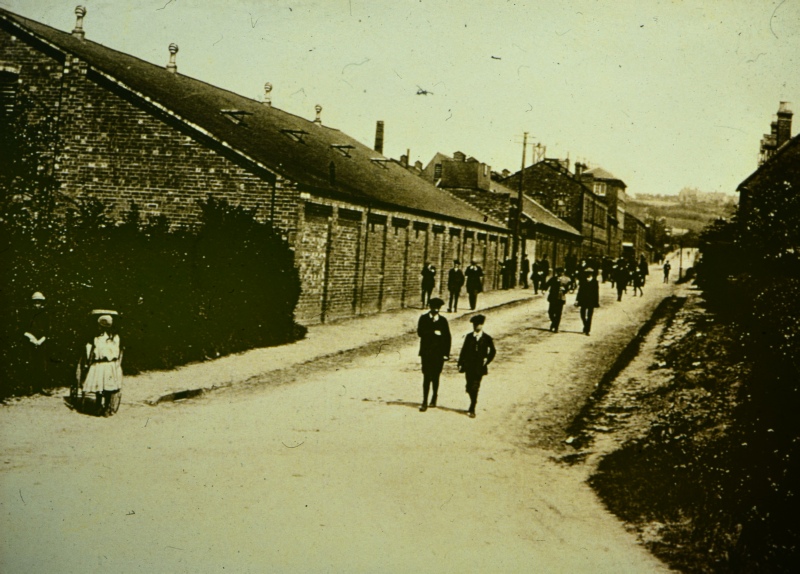
The Hunt End Givry Works
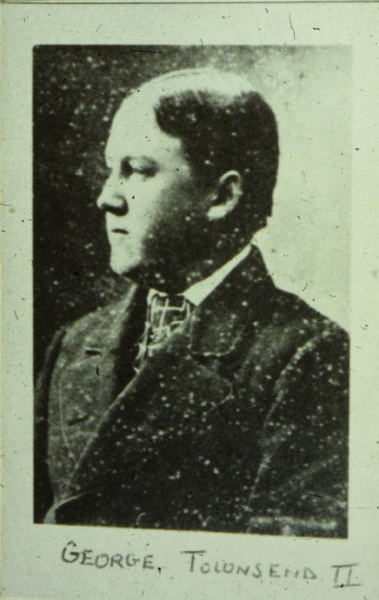
George Townsend
Albert Eadie
In the early 1800s England had the reputation of being a gin-sodden nation. The government was anxious to get the nation off gin and on to beer, said to be healthier, also the growing of hops and their brewing was good for the economy. Consequently, the Beerhouse Act of 1830 was passed, it allowed anyone of good character to brew and sell beer either from a public house or their own home for a licence of just under £2.
The result was that anyone with a spare corner in their kitchen was brewing and selling beer. Some people made a considerable amount of money, among them George Townsend, the son of an Alcester needlemaker. For about five years his huge black iron vat for brewing beer stood outside the Red Lion at Hunt End. He made enough money to build a little needle factory nearby that he named Givry Works ‘after a dear friend’.
In the 1830s, all the land in the Crabbs Cross area was owned by Farmer Eades. Then he sold a small piece of ground to William Welch to build a needle mill. Welch had a relative who was so taken with the needle mill that he asked Farmer Eades for permission to build an identical mill a bit further along the road. Consequently two identical mills were built, the oldest was Ashberry House, near the top end of Enfield Road (number 66), and the second was Givry Works, halfway along.
Townsend prospered and by 1871, he was employing 170 needlemakers. Living near the factory, I heard plenty of old anecdotes. George Townsend had not been a popular employer, when one of his employees was off sick he had sent a horse and cart to bring him back to work. On another occasion, when a young lady told him that she wanted to leave, he said that if she left, all her family were to go with her.
Townsend died and his son, George Townsend II took over. There’s a whiff of a scandal here, as Foster Townsend, the illegitimate son of his housekeeper, now appears on the scene. Townsend’s wife moved into a house up the hill nearer Crabbs Cross. However, George Townsend II and Foster became great friends and together they began the bicycle business. The modern safety bicycle with two wheels of equal size had recently appeared on the market, Foster took one into the factory and they both had a laugh. It had triangular wooden pedals, an iron backbone and wooden wheels. Townsend II was certain he could make a better bicycle. At first Townsend II only made bicycle parts but soon moved on to producing the entire machine. They were well-made with a sturdy frame and were very popular.
He had a stroke of luck - one of his employees was messing about with a chain in a shed at Crabbs Cross when he discovered that it was possible to make a spring and a saddle with one length of chain. It sold well as Townsend’s saddle and spring. Townsend was also helped by the fact that one of his employees, Fred Shelton, was a champion cyclist. Whenever Townsend wanted to impress a new buyer he summoned Fred who mounted a bicycle and whizzed up Littlewoods Hill as if the bike had wings.
If you take a look at the tiny Wharrage brook in Enfield Road you will understand why, in 1890, Townsend decided to install underground boilers. This was a disaster. First of all an employee, Henry Wiggett, was killed while steering a boiler into a correct position. Then the company went bankrupt.
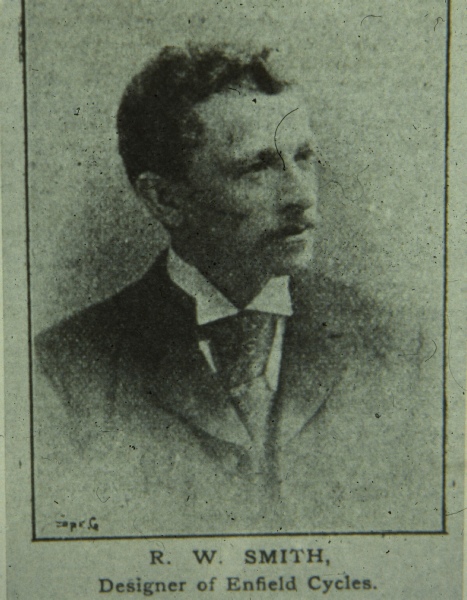
Townsend left and the financiers brought in two new managers. The first, Robert Walker Smith (usually known as R W) was a brilliant engineer. He would scribble a new invention on a scrap of paper and before the tool room had finished making it, another invention would be on its way. R W had worked in Coventry and he persuaded many of his colleagues to join him in Redditch. Some of them came by train on Monday morning then stayed in Redditch all the week. This meant that they were on their own each week day evening and so a leisure centre was built for them. It’s still there, across the road from Crabbs Cross School,
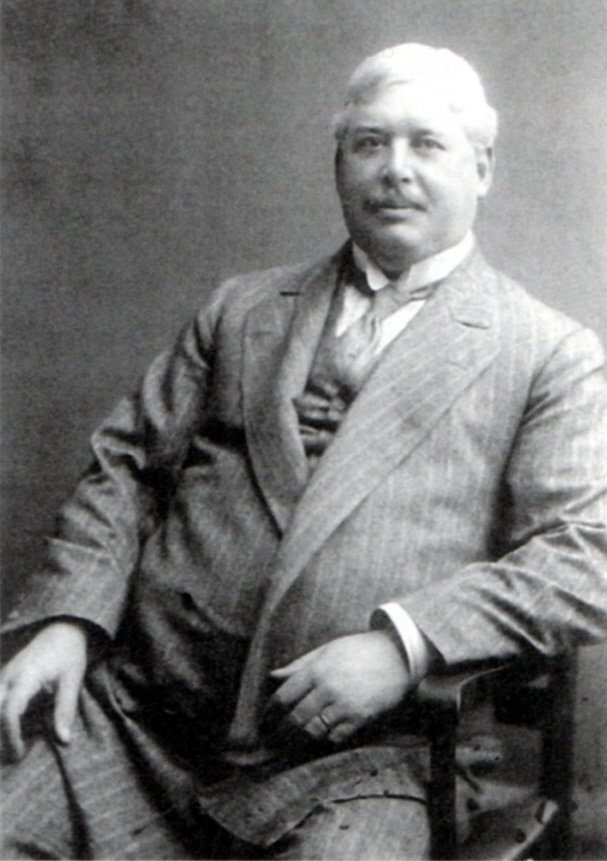
The second person to join R W’s team was Albert Eadie, said to be the best salesman England had ever known. He was a large man, over six feet tall and broad with it. He was full of fun and very much in demand on sports days. He appeared for work each morning wearing a brightly coloured waistcoat and a Stetson. His telegraphic address was EMPEROR Redditch. He went through the factory most mornings calling out a greeting to all the workers. Everybody liked him. Unofficially, Givry Works changed its name to ‘The Eadie Factory’. One of its official names was The New Enfield Cycle Company Limited. The road past the house was originally Hunt End Lane but it was now changed to Enfield Road. In 1897, Eadie built his own factory in Union Street known as the Eadie Manufacturing Company.
Eadie and Smith’s first task was to put the company on a sound financial footing. The bank managed to persuade George Cartland (husband of the famous author and the founder of Edgbaston Cricket club) to give them a generous loan. Then Eadie and Smith sold the needle manufacturing side of the business to Alfred Shrimpton and Sons, of Britannia Works.
An ex-employee who left the company during the reign of Townsends II, happened to work at the Royal Small Arms Company in Enfield, Middlesex. He managed to acquire for RW and Eadie a lucrative order of small parts for the Enfield rifle. The company was now on a firm financial footing. To celebrate, they called their next bicycle ‘The Enfield’. Albert Eadie added the word ‘Royal’ to make the bikes sound more upmarket.
The company was going well but then in 1901 RW and Eadie made a disastrous decision. They decided to go into car manufacture. Their first car was simply an engine clamped between two bicycles, named a Quadricyle. They were surprisingly robust, one survived a trip to Scotland and back.
One day R W Smith was driving past the Stag at Redhill, Stratford-upon-Avon, when his quadrycle overturned. He nearly lost his arm. However, as soon as he was out of hospital he was tinkering about with cars again. The bicycles were doing so well that they had moved into a new site off Hewell Road, leaving cars only at Givry Works with the new name of Enfield Autocar. It is said that all kinds of strange shapes emerged through the Givry gates. However, while the bicycles boomed, the cars went from disaster to disaster. It was not until 1906 that they were able to make a reliable, smart little vehicle with a short delivery time.
In 1907 they made a loss of £19,264. Albert Eadie said that if the shareholders would raise £8,000, he would match it out of his own pocket, but they refused. Enfield Autocar came to an end and were sold to to Alldays and Onions in Sparkbrook, Birmingham. The Enfield Autocar workers were devastated. One of the Engineers choked as he was recorded saying that there were enough finished cars on the Givry drive to cover their debts.
The factory ended in a most spectacular fashion. By 1964, Givry Works was owned by Dunlops who stored spent tyres there. One of the caretakers liked a hot lunch so at midday he would take an old tyre up to the top floor, spread it out, put his little stove in the centre and heat his lunch. Unfortunately, one day he went to sleep. When the fire brigade arrived they discovered that all the water pipes in Redditch were (what they described as) Victorian and very narrow, and totally impossible to carry enough water to put out a fire. They had to get water from Redditch. The blaze was seen three miles away.
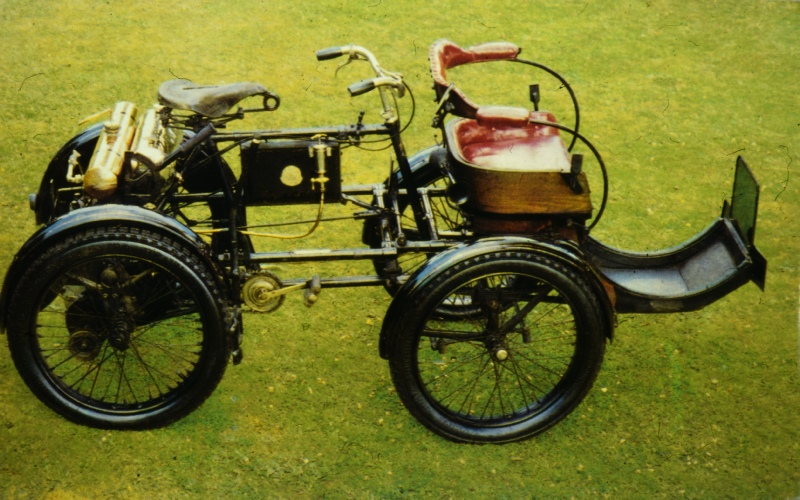
An Early Quadrycle