


Page 10 - HB- Bordesley Abbey
P. 10
Redditch Heritage                                                                      Bordesley Abbey


        Confiscated


        The monks of Bordesley had plenty of warning that their house was to be confiscated by
        the  Crown,  and  quite  naturally  took  all  possible  steps  to  protect  their  future.  It  is
        significant that immediately after the seizure not only did the monks leave the Abbey,
        but the township was also depopulated.

        It was many years before numbers again became sufficient for the Gatehouse Chapel of
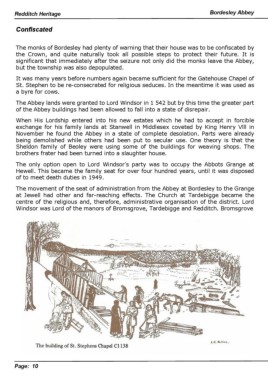
        St. Stephen to be re-consecrated for religious seduces. In the meantime it was used as
        a byre for cows.

        The Abbey lands were granted to Lord Windsor in 1 542 but by this time the greater part
        of the Abbey buildings had been allowed to fall into a state of disrepair.

        When  His  Lordship  entered  into  his  new  estates  which  he  had  to  accept  in  forcible
        exchange for his family lands at Stanwell in Middlesex coveted by King  Henry Vlll in
        November he found the Abbey in a state of complete desolation. Parts were already
        being  demolished  while  others  had  been  put  to  secular  use.  One  theory  is  that  the
        Sheldon  family  of  Beoley  were  using  some  of  the  buildings  for  weaving  shops.  The
        brothers frater had been turned into a slaughter house.

        The  only  option  open  to  Lord  Windsor's  party  was  to  occupy  the  Abbots  Grange  at
        Hewell. This became the family seat for over four hundred years, until it was disposed
        of to meet death duties in 1949.


        The movement of the seat of administration from the Abbey at Bordesley to the Grange
        at  Jewell  had  other  and  far-reaching  effects.  The  Church  at  Tardebigge  became  the
        centre of the religious and, therefore, administrative organisation of the district. Lord
        Windsor was Lord of the manors of Bromsgrove, Tardebigge and Redditch. Bromsgrove


       Page:  10

