


Page 25 - Moons Moat
P. 25
Moons Moat                                                                           Redditch Heritage


       Excavation  of  the  banks  of  the
       island  revealed  that  a  continuous
       inner  perimeter  wall  was  running
       along the lower edge of the moat’s
       scarp. It was in a large foundation
       trench and was made up of red and
       but  mostly  white  sandstone  and
       bits  of  tile  and  mortar.  Originally
       the side facing the moat had been
       covered  with  a  white  mortar  and
       capped  with  flat  sandstone  slabs.
       It was suggested that some of this
       stone     had      come      from      an
       ecclesiastical       building        and
       Bordesley       Abbey      has      been
       suggested as a source.


       After removal of the causeway on
       the  northern  arm  of  the  moat  a
       white      sandstone        pier     was
       uncovered which was built into the
       wall    which      surrounded        and
       enclosed the island. The stone was
       well  dressed  and  measured  4.5
       metres long and projected 3 metres
       into the moat. Two large post-holes
       at the top of the feature probably
       represented supports for a bridge
       structure.

       The moat measured between 7 to
       8  metres  across  and  would  have
       held water to a depth of about 1.5
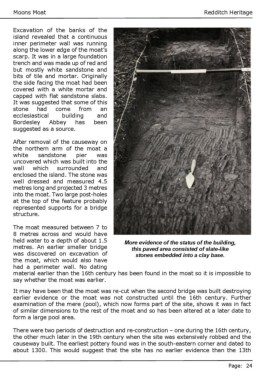
                                                        More evidence of the status of the building,
       metres.  An  earlier  smaller  bridge               this paved area consisted of slate-like
       was  discovered  on  excavation  of                   stones embedded into a clay base.
       the  moat,  which  would  also  have
       had  a  perimeter  wall.  No  dating
       material earlier than the 16th century has been found in the moat so it is impossible to
       say whether the moat was earlier.

       It may have been that the moat was re-cut when the second bridge was built destroying
       earlier  evidence  or  the  moat  was  not  constructed  until  the  16th  century.  Further
       examination of the mere (pool), which now forms part of the site, shows it was in fact
       of similar dimensions to the rest of the moat and so has been altered at a later date to
       form a large pool area.


       There were two periods of destruction and re-construction – one during the 16th century,
       the other much later in the 19th century when the site was extensively robbed and the
       causeway built. The earliest pottery found was in the south-eastern corner and dated to
       about  1300.  This  would  suggest  that  the  site  has  no  earlier  evidence  than  the  13th


                                                                                                       Page:  24

