


Page 15 - The Palace @ 100
P. 15
A Mixed Fare


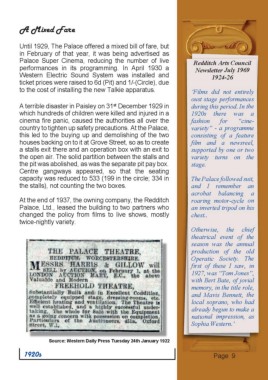
          Until 1929, The Palace offered a mixed bill of fare, but
          in  February  of  that  year,  it  was  being  advertised  as
          Palace  Super  Cinema,  reducing  the  number  of  live                      Redditch Arts Council
          performances  in  its  programming.  In  April  1930  a                       Newsletter July 1969
          Western  Electric  Sound  System  was  installed  and                                1924-26
          ticket prices were raised to 6d (Pit) and 1/-(Circle), due
          to the cost of installing the new Talkie apparatus.                         ‘Films  did  not  entirely

                                                                                      oust stage performances
                                                   st
          A terrible disaster in Paisley on 31  December 1929 in                      during this period. In the
          which hundreds of children were killed and injured in a                     1920s  there  was  a
          cinema fire panic, caused the authorities all over the                      fashion      for     “cine-
          country to tighten up safety precautions. At the Palace,                    variety” - a programme
          this led to the buying up and demolishing of the two                        consisting  of  a  feature
          houses backing on to it at Grove Street, so as to create                    film  and  a  newsreel,
          a stalls exit there and an operation box with an exit to                    supported by one or two
          the open air. The solid partition between the stalls and                    variety  turns  on  the
          the pit was abolished, as was the separate pit pay box.                     stage.
          Centre  gangways  appeared,  so  that  the  seating
          capacity was reduced to 533 (199 in the circle; 334 in                      The Palace followed suit,
          the stalls), not counting the two boxes.                                    and  I  remember  an
                                                                                      acrobat  balancing  a
          At the end of 1937, the owning company, the Redditch                        roaring  motor-cycle  on
          Palace, Ltd., leased the building to two partners who                       an inverted tripod on his
          changed  the  policy  from  films  to  live  shows,  mostly                 chest..
          twice-nightly variety.
                                                                                      Otherwise,  the  chief
                                                                                      theatrical  event  of  the
                                                                                      season  was  the  annual
                                                                                      production  of  the  old
                                                                                      Operatic  Society.  The
                                                                                      first  of  these  I  saw,  in
                                                                                      1927, was “Tom Jones”,
                                                                                      with Bert Bate, of jovial
                                                                                      memory, in the title role,
                                                                                      and  Mavis  Bennett,  the
                                                                                      local  soprano,  who  had
                                                                                      already begun to make a
                                                                                      national  impression,  as
                                                                                      Sophia Western.’


                       Source: Western Daily Press Tuesday 24th January 1922

           1920s                                                                                Page  9

