


Page 19 - The Health OF Redditch
P. 19
The Health Of Reditch


               Boards of areas near Birmingham, including Redditch, advised inhabitants not to attend the
               Birmingham Onion Fair.  45


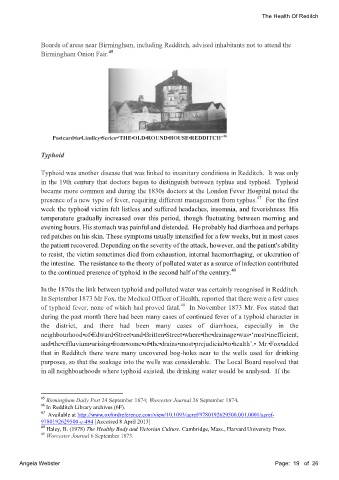
                   Postcard•in•Lindley•Series•‘THE•OLD•ROUND•HOUSE•REDDITCH’   46


               Typhoid

               Typhoid was another disease that was linked to insanitary conditions in Redditch. It was only
               in the 19th century that doctors began to distinguish between typhus and typhoid.  Typhoid
               became more common and during the 1830s doctors at the London Fever Hospital noted the
                                                                                           47
               presence of a new type of fever, requiring different management from typhus.   For the first
               week the typhoid victim felt listless and suffered headaches, insomnia, and feverishness. His
               temperature gradually increased  over  this period,  though fluctuating between morning  and
               evening hours. His stomach was painful and distended.  He probably had diarrhoea and perhaps
               red patches on his skin. These symptoms usually intensified for a few weeks, but in most cases
               the patient recovered. Depending on the severity of the attack, however, and the patient's ability
               to resist, the victim sometimes died from exhaustion, internal haemorrhaging, or ulceration of
               the intestine.  The resistance to the theory of polluted water as a source of infection contributed
               to the continued presence of typhoid in the second half of the century. 48


               In the 1870s the link between typhoid and polluted water was certainly recognised in Redditch.
               In September 1873 Mr Fox, the Medical Officer of Health, reported that there were a few cases
                                                                49
               of typhoid fever, none of which had proved fatal.   In November 1873 Mr. Fox stated that
               during the past month there had been many cases of continued fever of a typhoid character in
               the  district,  and  there  had  been  many  cases  of  diarrhoea,  especially  in  the
               neighbourhood•of•Edward•Street•and•Britten•Street•where•the•drainage•was•‘most•inefficient,
               and•the•effluvium•arising•from•some•of•the•drains•most•prejudicial•to•health’.• Mr.•Fox•added
               that  in Redditch  there were many uncovered bog-holes near to  the wells used for drinking
               purposes, so that the soakage into the wells was considerable.  The Local Board resolved that
               in all neighbourhoods where typhoid existed, the drinking water would be analysed.  If the


               45
                  Birmingham Daily Post 24 September 1874; Worcester Journal 26 September 1874.
               46
                  In Redditch Library archives (6F).
               47
                   Available at http://www.oxfordreference.com/view/10.1093/acref/9780192629500.001.0001/acref-
               9780192629500-e-494 [Accessed 8 April 2013]
               48
                  Haley, B. (1978) The Healthy Body and Victorian Culture. Cambridge, Mass., Harvard University Press.
               49
                  Worcester Journal 6 September 1873.


        Angela Webster                                                                            Page:  19  of  26

