


Page 8 - Partridge & Spencers
P. 8
Redditch Heritage                                                             Partridge’s & Spencer’s


        So it would seem that prior to the 19th century the Partridge and Spencer families shared a
        companion environment since both were agricultural labourers in their respective counties  before
        the Industrial Revolution. Typically they would have had very little formal education leaving school
        at ten or earlier; the daughters becoming servants and living away from home with the sons
        staying at home but working locally on the land and marrying mostly in their late teens. Only a
        social upheaval could change this century’s old way of life and it came in the form of the Industrial
        Revolution. By the 19th century the Partridges had moved from the land at Ipsley to nearby
        Redditch and were working in the factory system. Edwin Partridge's apprenticeship indenture of
        1836 (now in the Forge Mill Needle Museum, Redditch) is witness to this. The Spencers, as we
        have seen, left the land for the needle trade a few decades later when they moved to Redditch
        which by the 1850's had been transformed from a market to an established industrialised town.


        A Dangerous Business


        It should be noted that both the fish hook and needle industries gave rise to a dangerous health
        hazard: steel dust. This pernicious by-product of grinding operations (required to produce the
        essential point to the hook and needle) entered the workers' lungs causing diseases as deadly
        as coal dust for miners. It was known colloquial as “Pointers Rot”. Life expectancy for men in
        both the needle and fish hook trades did not go beyond the early thirties. A Specer born at
        Feckenham, a needle pointer by trade, died in Long Crendon at the age of only twenty nine from
        this cause.
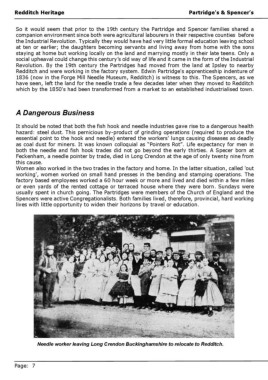
        Women also worked in the two trades in the factory and home. In the latter situation, called 'out
        working', women worked on small hand presses in the bending and stamping operations. The
        factory based employees worked a 60 hour week or more and lived and died within a few miles
        or even yards of the rented cottage or terraced house where they were born. Sundays were
        usually spent in church going. The Partridges were members of the Church of England and the
        Spencers were active Congregationalists. Both families lived, therefore, provincial, hard working
        lives with little opportunity to widen their horizons by travel or education.


                 Needle worker leaving Long Crendon Buckinghamshire to relocate to Redditch.


       Page:  7

