


Page 4 - Swindon Line Monitoring
P. 4
Remembering ISTEL - Memories of Swindon Line Monitoring - Rogan Meadows

        Press Line Monitoring – the original system development, 1976 – 1978.


        I left Solihull in 1976 to join a team based in the Swindon Pressing Plant. Most of that early team
        were from the Oxford area and we had an allocated “team” vehicle to do the daily run between Oxford
        and Swindon. The vehicle, a Maxi, came out of the Swindon garage car pool. The team was headed
        up by Mike Grant (AKA The Guv.) who reported to Mike Grice. As well as myself, the team comprised
        Cliff Shuker, Adrian Faulkner, John Snook, Roger Gray and a couple of Swindon staff supplying their
        knowledge of press shop planning.

        Adrian became the team driver and picked up myself from Oxford, Cliff Shuker from Garsington and
        John Snook from Grove and returned us on a daily basis. This worked well until the Friday late
        evening when Adrian took the car in to Cowley Pressings plant to refuel ready for the next week.
        Cowley Security recognised the car as a Swindon plant car and arrested Adrian on suspicion of
        illegal use. As it was late there was no one in the Swindon garage to vouch for Adrians’ possession
        of the car and it took some time to obtain the necessary authorisation for his release.

                                                      st
        Our  work  area  at  Swindon  was  on  the  1   floor,  inside  with  no  windows,  directly  above  a  die
        manufacturing heat treatment area. In 1976 it was a hot summer, and we took towels in to work to
        sit on our plastic chairs. Our first task was to carry out a series of presentations to all workers, staff
        and managers explaining how the system would work, what it would do, what the benefits were and
        what savings would be made, including some roles that would become redundant (not a popular
        concept in those strong union days!).

        Additionally, because each press stroke was detected, the computer knew when and for how long
        each press was idle. The relevant foreman’s job was to account for non-activity. Each would use a
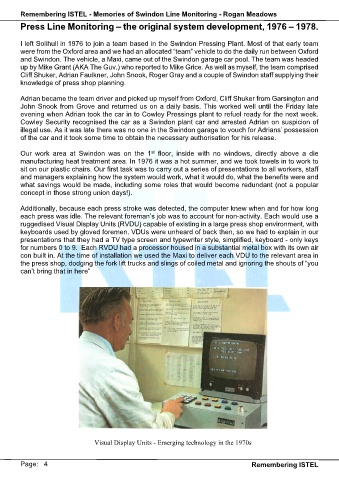
        ruggedised Visual Display Units (RVDU) capable of existing in a large press shop environment, with
        keyboards used by gloved foremen. VDUs were unheard of back then, so we had to explain in our
        presentations that they had a TV type screen and typewriter style, simplified, keyboard - only keys
        for numbers 0 to 9.  Each RVDU had a processor housed in a substantial metal box with its own air
        con built in. At the time of installation we used the Maxi to deliver each VDU to the relevant area in
        the press shop, dodging the fork lift trucks and slings of coiled metal and ignoring the shouts of “you
        can’t bring that in here”


                                  Visual Display Units - Emerging technology in the 1970s


        Page:   4                                                                        Remembering ISTEL

