


Page 5 - Swindon Line Monitoring
P. 5
Remembering ISTEL - Memories of Swindon Line Monitoring - Rogan Meadows


                                                                    st
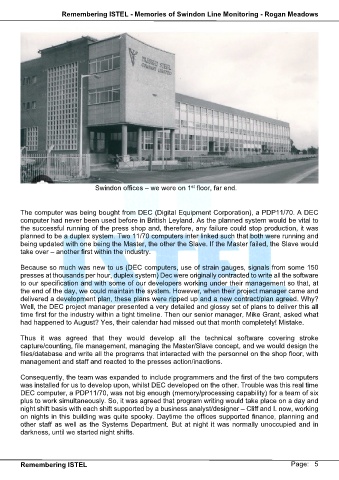
                                   Swindon offices – we were on 1  floor, far end.


        The computer was being bought from DEC (Digital Equipment Corporation), a PDP11/70. A DEC
        computer had never been used before in British Leyland. As the planned system would be vital to
        the successful running of the press shop and, therefore, any failure could stop production, it was
        planned to be a duplex system. Two 11/70 computers inter linked such that both were running and
        being updated with one being the Master, the other the Slave. If the Master failed, the Slave would
        take over – another first within the industry.

        Because so much was new to us (DEC computers, use of strain gauges, signals from some 150
        presses at thousands per hour, duplex system) Dec were originally contracted to write all the software
        to our specification and with some of our developers working under their management so that, at
        the end of the day, we could maintain the system. However, when their project manager came and
        delivered a development plan, these plans were ripped up and a new contract/plan agreed. Why?
        Well, the DEC project manager presented a very detailed and glossy set of plans to deliver this all
        time first for the industry within a tight timeline. Then our senior manager, Mike Grant, asked what
        had happened to August? Yes, their calendar had missed out that month completely! Mistake.


        Thus  it  was  agreed  that  they  would  develop  all  the  technical  software  covering  stroke
        capture/counting, file management, managing the Master/Slave concept, and we would design the
        files/database and write all the programs that interacted with the personnel on the shop floor, with
        management and staff and reacted to the presses action/inactions.

        Consequently, the team was expanded to include programmers and the first of the two computers
        was installed for us to develop upon, whilst DEC developed on the other. Trouble was this real time
        DEC computer, a PDP11/70, was not big enough (memory/processing capability) for a team of six
        plus to work simultaneously. So, it was agreed that program writing would take place on a day and
        night shift basis with each shift supported by a business analyst/designer – Cliff and I. now, working
        on nights in this building was quite spooky. Daytime the offices supported finance, planning and
        other staff as well as the Systems Department. But at night it was normally unoccupied and in
        darkness, until we started night shifts.


        Remembering ISTEL                                                                              Page:   5

