


Page 24 - High Duty Alloys
P. 24
Redditch Heritage                                                                      High Duty Alloys


       Keeping Redditch Awake


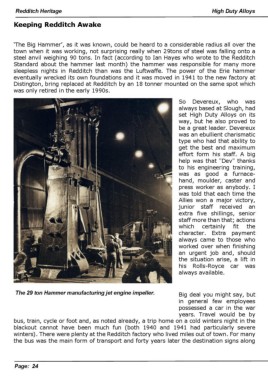
       ‘The Big Hammer’, as it was known, could be heard to a considerable radius all over the
       town when it was working, not surprising really when 29tons of steel was falling onto a
       steel anvil weighing 90 tons. In fact (according to Ian Hayes who wrote to the Redditch
       Standard about the hammer last month) the hammer was responsible for many more
       sleepless  nights  in  Redditch  than  was  the  Luftwaffe.  The  power  of  the  Erie  hammer
       eventually wrecked its own foundations and it was moved in 1941 to the new factory at
       Distington, bring replaced at Redditch by an 18 tonner mounted on the same spot which
       was only retired in the early 1990s.


                                                                                So  Devereux,  who  was
                                                                                always based at Slough, had
                                                                                set  High  Duty  Alloys  on  its
                                                                                way, but he also proved to
                                                                                be a great leader. Devereux
                                                                                was an ebullient charismatic
                                                                                type who had that ability to
                                                                                get the best and maximum
                                                                                effort  form  his  staff.  A  big
                                                                                help was that "Dev" thanks
                                                                                to  his  engineering  training,
                                                                                was  as  good  a  furnace-
                                                                                hand,  moulder,  caster  and
                                                                                press worker as anybody. I
                                                                                was told that each time the
                                                                                Allies  won  a  major  victory,
                                                                                junior  staff  received  an
                                                                                extra  five  shillings,  senior
                                                                                staff more than that; actions
                                                                                which      certainly     fit   the
                                                                                character.  Extra  payment
                                                                                always  came  to  those  who
                                                                                worked over when finishing
                                                                                an  urgent  job  and,  should
                                                                                the  situation  arise,  a  lift  in
                                                                                his  Rolls-Royce  car  was
                                                                                always available.


        The 29 ton Hammer manufacturing jet engine impeller.                    Big deal you might say, but

                                                                                in  general  few  employees
                                                                                possessed  a  car  in  the  war
                                                                                years.  Travel  would  be  by
       bus, train, cycle or foot and, as noted already, a trip home on a cold winters night in the
       blackout  cannot  have  been  much  fun  (both  1940  and  1941  had  particularly  severe
       winters). There were plenty at the Redditch factory who lived miles out of town. For many
       the bus was the main form of transport and forty years later the destination signs along


       Page:  24

