


Page 30 - High Duty Alloys
P. 30
Redditch Heritage                                                                      High Duty Alloys


       Post War Development


                                                          th
       VE Day – Victory in Europe Day on May 8  1945 – saw a big party in the works canteen
                                                         but the war's end brought a falling off of work
                                                         levels and consequent staff reductions – again
                                                         there was a film of the VE Day celebrations in
                                                         the  HDA  archives.  In  1945  the  High  Duty
                                                         workforce across all three sites totalled 13,000,
                                                         but an order value that dropped from £28m to
                                                         £3m pounds brought a reduction to 6,000 and
                                                         it was to be a few years before civil aircraft work
                                                         began  to  fill  in  the  gaps.  However  the
                                                         development of the jet engine ensured that the
                                                         RAF had to re-equip with modern aircraft and
                                                         that helped to keep orders flowing in.


                                                         Although we have reached the end of the war,
                                                         those first six years form only a small part in the
                                                         history and success of High Duty Alloys. I would
                                                         just like to spend a few minutes discussing the
                                                         highlights in the years that followed.

                                                         The advances in aviation pushed the need for
                                                         ever  bigger  forgings  and  the  HDA  board
                                                         eventually took the decision after several years
                                                         of  independent  study,  and  with  no  financial
                                                         support  from  the  Government,  to  install  a
                                                         12,000  ton  hydraulic  press.  The  columns  and
                                                         cylinders were ordered in April and June 1951.

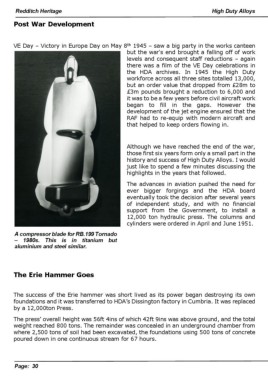
       A compressor blade for RB.199 Tornado
       –  1980s.  This  is  in  titanium  but
       aluminium and steel similar.


       The Erie Hammer Goes


       The success of the Erie hammer was short lived as its power began destroying its own
       foundations and it was transferred to HDA’s Dissington factory in Cumbria. It was replaced
       by a 12,000ton Press.

       The press’ overall height was 56ft 4ins of which 42ft 9ins was above ground, and the total
       weight reached 800 tons. The remainder was concealed in an underground chamber from
       where 2,500 tons of soil had been excavated, the foundations using 500 tons of concrete
       poured down in one continuous stream for 67 hours.


       Page:  30

