


Page 7 - L&T William Avery
P. 7
William Avery                                                                          Redditch Heritage


       WILLIAM AVERY 1832-1899


       Inroduction

                                                                                1
       Dr. Page introduced his ‘In Memoriam Mr. William Avery’  by stating that ‘William Avery
       had ‘for sixty years ... taken a prominent part in the public, social and religious life of the
       town and neighbourhood’. He concluded:


             William Avery was distinguished by generous sympathy, which showed itself in
             a  willingness  to  render  ready  help  to  all,  transparent  simplicity,  sincerity,
             integrity, and unostentatiousness; by charity, love of fairness, and invariable
             wit and good humour. These secured the affectionate esteem of all who knew
             him. His example and the remembrance of his work and name will ever survive
             in local fame and history.


                                                                                          2
       William  Avery  was  born  in  Headless  Cross  on  1st  May,  1832.   He  received  his  early
                                                                                                                 3
       education  ‘in  the  two  chief  scholastic  establishments  situated  in  Evesham  St.’.   The
       schools may have been those of Thomas T. Shore and William Henry Tomlinson.  He then
                                                                                                             4
       he went to the Wesleyan College (later Queen’s College), Taunton. The college aimed to
       provide ‘a regular and liberal course of education’.            5


       Manufacturer of needles and needle cases

       At  a  relatively  early  age  William  Avery  was
       initiated by his father, John Avery, (died 25 June
       1865 aged 58 ) into the ‘art and craft’ of needle
                         6
       making. In later years, he was well known in the
       Redditch area as the successful head of W. Avery
       &  Son,  as  a  manufacturer  of  needles  and
       inventor  of  needle  cases.  The  needle  cases
       included  models  of  for  example,  a  hat  box,  a
       drum, a chair, Shakespeare’s birth place and a
       wishing  well.  At  the  Exposition  Universelle
       (1889)  in  Paris  the  W.  Avery  &  Son’s  display
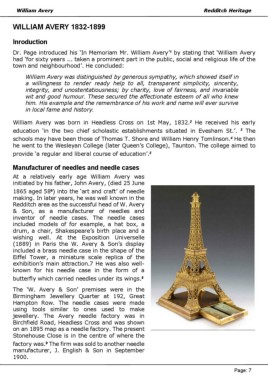
       included a brass needle case in the shape of the
       Eiffel  Tower,  a  miniature  scale  replica  of  the
       exhibition’s main attraction.7 He was also well-
       known  for  his  needle  case  in  the  form  of  a
       butterfly which carried needles under its wings.            8


       The  ‘W.  Avery  &  Son’  premises  were  in  the
       Birmingham  Jewellery  Quarter  at  192,  Great
       Hampton  Row.  The  needle  cases  were  made
       using  tools  similar  to  ones  used  to  make
       jewellery.  The  Avery  needle  factory  was  in
       Birchfield Road, Headless Cross and was shown
       on an 1895 map as a needle factory. The present
       Stonehouse Close is in the centre of where the
                      9
       factory was.  The firm was sold to another needle
       manufacturer,  J.  English  &  Son  in  September
       1900.


                                                                                                              Page: 7

