


Page 8 - L&T William Avery
P. 8
Redditch Heritage                                                                           William Avery


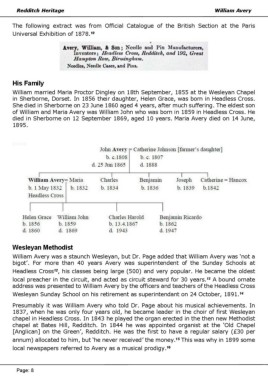
       The  following  extract  was  from  Official  Catalogue  of  the  British  Section  at  the  Paris
       Universal Exhibition of 1878.       10


       His Family
       William married Maria Proctor Dingley on 18th September, 1855 at the Wesleyan Chapel
       in Sherborne, Dorset. In 1856 their daughter, Helen Grace, was born in Headless Cross.
       She died in Sherborne on 23 June 1860 aged 4 years, after much suffering. The eldest son
       of William and Maria Avery was William John who was born in 1859 in Headless Cross. He
       died in Sherborne on 12 September 1869, aged 10 years. Maria Avery died on 14 June,
       1895.


       Wesleyan Methodist

       William Avery was a staunch Wesleyan, but Dr. Page added that William Avery was ‘not a
       bigot’.  For  more  than  40  years  Avery  was  superintendent  of  the  Sunday  Schools  at
                          12
       Headless Cross , his classes being large (500) and very popular. He became the oldest
                                                                                                 13
       local preacher in the circuit, and acted as circuit steward for 30 years.  A bound ornate
       address was presented to William Avery by the officers and teachers of the Headless Cross
       Wesleyan Sunday School on his retirement as superintendant on 24 October, 1891.                           14

       Presumably it was William Avery who told Dr. Page about his musical achievements. In
       1837, when he was only four years old, he became leader in the choir of first Wesleyan
       chapel in Headless Cross. In 1843 he played the organ erected in the then new Methodist
       chapel  at  Bates  Hill,  Redditch.  In  1844  he  was  appointed  organist  at  the  ‘Old  Chapel
       [Anglican] on the Green’, Redditch. He was the first to have a regular salary (£30 per
                                                                                   15
       annum) allocated to him, but ‘he never received’ the money.  This was why in 1899 some
       local newspapers referred to Avery as a musical prodigy.                16


         Page: 8

