


Page 232 - Redditch People
P. 232
Redditch People

William Valentine Mayneord CBE FRS

Pioneer in Medical Physics

Willian was a pioneer in the field of Medical Physics
including raioagrpahy. He was a member of the
Royal Society and was awarded a CBE in 1965 for his
medical research.

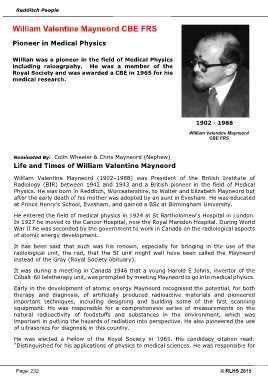
                                                                                                      1902 - 1988

                                                                                                                      William Valentine Mayneord
                                                                                                                                   CBE FRS

Nominated By: Colin Wheeler & Chris Mayneord (Nephew)

Life and Times of William Valentine Mayneord

William Valentine Mayneord (1902–1988) was President of the British Institute of
Radiology (BIR) between 1942 and 1943 and a British pioneer in the field of Medical
Physics. He was born in Redditch, Worcestershire, to Walter and Elizabeth Mayneord but
after the early death of his mother was adopted by an aunt in Evesham. He was educated
at Prince Henry's School, Evesham, and gained a BSc at Birmingham University.

He entered the field of medical physics in 1924 at St Bartholomew's Hospital in London.
In 1927 he moved to the Cancer Hospital, now the Royal Marsden Hospital. During World
War II he was seconded by the government to work in Canada on the radiological aspects
of atomic energy development.

It has been said that such was his renown, especially for bringing in the use of the
radiological unit, the rad, that the SI unit might well have been called the Mayneord
instead of the Gray (Royal Society obituary).

It was during a meeting in Canada 1946 that a young Harold E Johns, inventor of the
Cobalt-60 teletherapy unit, was prompted by meeting Mayneord to go into medical physics.

Early in the development of atomic energy Mayneord recognised the potential, for both
therapy and diagnosis, of artificially produced radioactive materials and pioneered
important techniques, including designing and building some of the first scanning
equipment. He was responsible for a comprehensive series of measurements on the
natural radioactivity of foodstuffs and substances in the environment, which was
important in putting the hazards of radiation into perspective. He also pioneered the use
of ultrasonics for diagnosis in this country.

He was elected a Fellow of the Royal Society in 1965. His candidacy citation read:
"Distinguished for his applications of physics to medical sciences. He was responsible for

Page: 232                                              © RLHS 2015

